

- 14/04/2026
- Endress+Hauser
Chip level control in the pulp digester
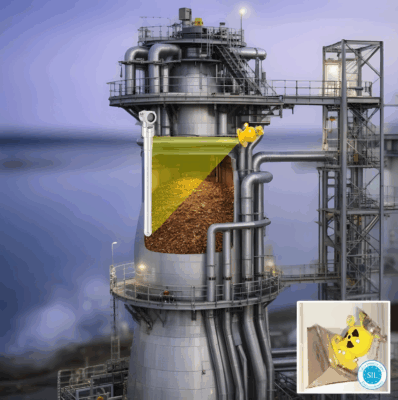
Accurate chip level control in a steam/liquor phase digester is essential for stable and efficient digester runnability. In this type of digester, level control consists of two interacting loops: the liquor level and the chip level. The liquor level is typically controlled by a differential pressure (dP) transmitter and the black liquor extraction flow, while the chip level is controlled by mechanical paddles in combination with the pulp blow flow.
A major operational challenge is varying chip buoyancy and chip density, which can disturb the downward movement of the chip column and cause floating, hanging, or uneven descent. One important advantage of steam/liquor phase digesters, however, is the ability to influence the downward driving force of the chip column by adjusting the chip level, i.e. the weight of chips above the liquor. The chip pile also provides a steaming retention time before the chips enter the cooking liquor, supporting better impregnation.
Stable chip column movement is achieved by balancing chip compaction and driving force. If the driving force is too high, excessive chip compaction increases liquor flow resistance, potentially leading to poor wash efficiency, low Kappa instability, and collapsing chips. If the force is too low, chips may be pulled out of the column and into the extraction system, increasing the risk of screen plugging or a chip column hang-up. Maintaining this balance is therefore critical for reliable operation.
High-resolution and accurate chip level measurement provides better control of the forces acting on the chip column. By modulating the chip height above the liquor to an optimum level, a steady downward push can be maintained. This helps keep digester screens clean and allows operation at a higher wash dilution factor. Adjusting chip height also makes it possible to compensate for variations in chip density and buoyancy. In practice, relatively small adjustments of about ±50 cm from the steady-state chip level are often sufficient to mitigate process disturbances.
Regarding level measurement technology, steam/liquor phase digesters allow chip pile measurement above the liquor level. Mechanical paddles are commonly used, where chip movement causes paddle deflection and torsion that is converted into an analogue signal to the DCS, often using two or three paddles as an array. A seamless and non-intrusive upgrade is gamma-radiometric chip level measurement. With an isotope source and a vertical gamma detector, a continuous measurement of up to four meters of chip pile can be achieved, providing smooth, uninterrupted real-time data to the DCS.
High-resolution gamma-based chip level control improves control of chip steaming retention time and the downward force of the chip pile, contributing to improved digester stability and overall process performance.
Source: Mr. Ulf Johansson