

- 29/01/2026
- Blogs
ABC (Advantage BalanceControl™) in Energy Saving
The continuous challenge for tissue makers will most likely be how to deal with the increasing demand for raw material, water and energy that follows in the wake of growing tissue consumption. Authorities around the world are increasing the environmental legislation demands on tissue production and consumers are asking for more environmentally friendly products.
One could say that for tissue producers, low consumptions and emissions are more important than ever. Merely a green image will however not be sufficient to be competitive – also actions are required. Since tissue production traditionally has been energy intensive, following the above statements, it is time for a change. It is time to evolve.
Quite often, when talking about energy saving, we focus on how to recycle energy from the tissue-making process. So let us now instead start from another direction, by reducing the demand. The first and most efficient step ought to be to decrease the consumption by utilizing Best Available Technology (BAT). The second step would then be to make the process more energy efficient and take advantage of integrated systems utilizing Best Mill Design and Best Operational Practices (BOP). Finally, as a last action, one would take care of the losses – if there are any left.
A – Reduce the Demand
Best press dryness
The most efficient way to reduce energy consumption in the tissue-making process is to improve the post-press dryness. An increased post-press dryness means significantly less water to evaporate on the Yankee dryer resulting in less energy being required. Let us look at an example. Calculated on an instantaneous production of 200 tons per day with an increased post-press dryness of just two percent, say from 44 to 46, means 98 kg less water to evaporate – per ton. This in turn means that the energy consumption can be reduced by 166 kWh per ton. With our best available technology, a post-press dryness of 48 percent can be achieved (in fact, today a level of 50 percent is being approached). A sheet containing half water and half fiber would in our example mean 272 kg less water to evaporate per ton.
Reducing the energy-demand essentially requires a holistic view of the tissue-making process, which takes into consideration all possible actions and technologies from stock preparation to reel. In addition to the above example, there is still a lot that can be done to decrease energy consumption. By reducing the flow through the headbox, the energy consumption of the approach system can be reduced, without sacrificing quality. The shower water set up using only clarified white water reduces the mill’s freshwater consumption, which indirectly contributes to a reduced demand for drying energy. Yankee head insulation prevents heat losses and thus reduces the steam consumption of the Yankee dryer. A direct drive instead of a gearbox for the refiner eliminates the need for cooling water and oil. When gearbox losses are eliminated power consumption is reduced. A new design of the machine screen can give further savings. These are only some examples of what can be done.
B – Make it more efficient
Best mill design for a reduced environmental load and production cost
An efficient mill design, seen from an environmental and cost point of view, contains integrated process solutions to ensure optimized interaction between all systems from pulp to paper. This is a fact which we have verified in our advanced simulation model. How the process equipment units are arranged relative to each other as well as the dimensioning of the equipment according to the products to be produced has a significant impact on energy consumption. Oversized equipment results in poor energy efficiency and runnability as well as in high production costs. The difference between installed power for worst mill design compared to best mill design is significant. Inadequate mill design and over dimensioned process equipment, on the other hand, can further increase power consumption for stock and water pumps.
From monitoring to energy operator – from passive to active
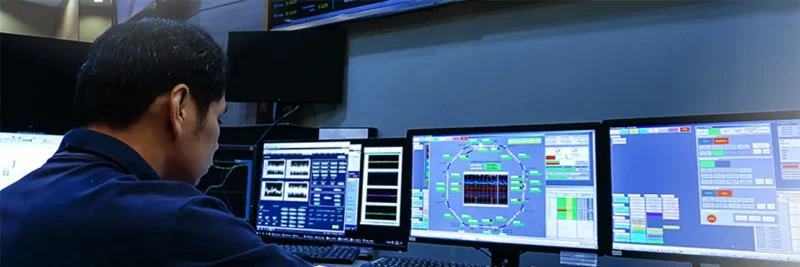
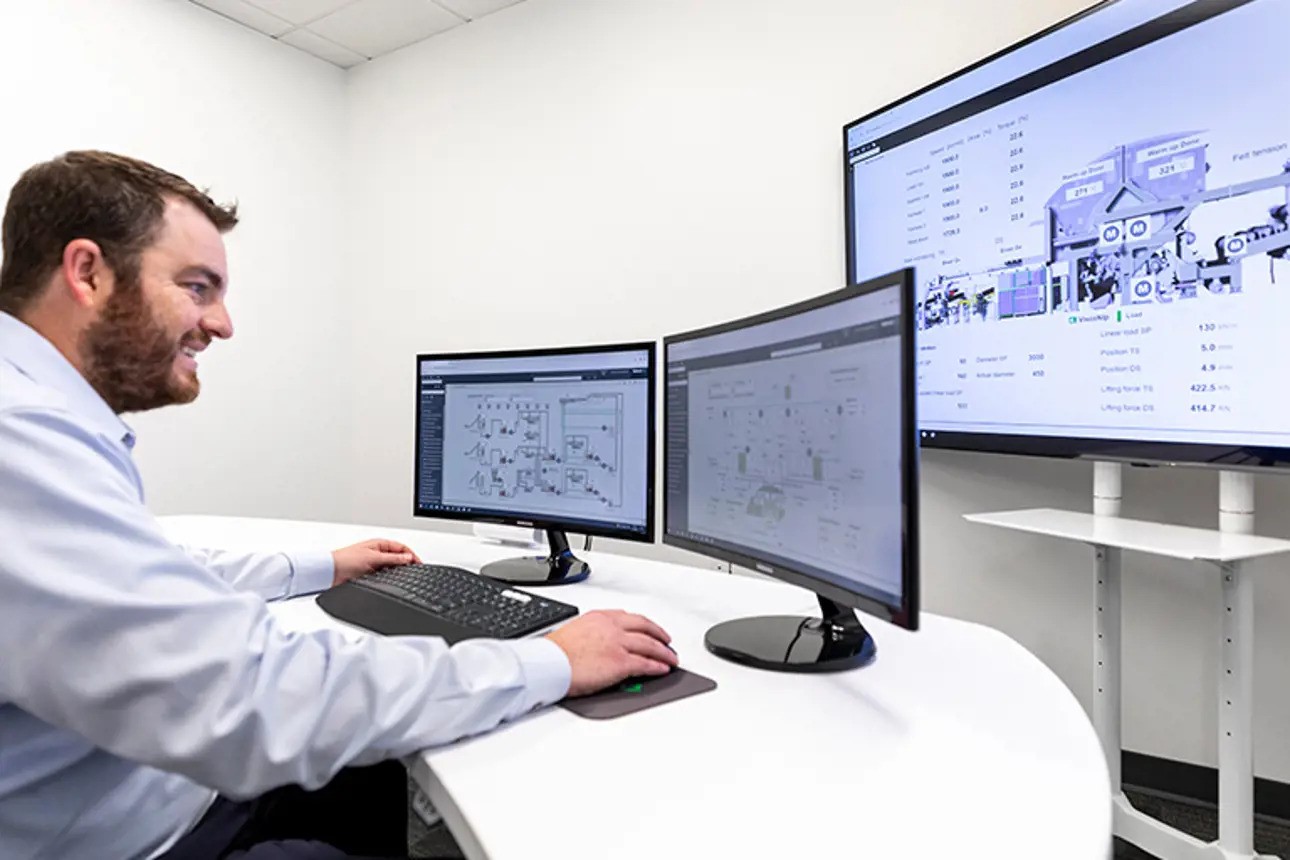
To meet the demand for a reduced environmental load and production cost, an integrated process solution for the complete tissue line is essential. Even though best available technology and best mill design are utilized, the “body” can’t move without its “brain”. An intelligent control system facilitates interaction between human beings and the process. It not only automatically controls the process and maintains center-line parameters. It also includes features such as valuable feedback on average and momentary energy and water consumption as well as online help dialogs and remote diagnostic possibilities for online support from experts.
Training
Monitoring is one tool for ensuring high-quality production. However, the operators also must be able to interpret the feedback from the systems and take actions in order to operate in the most energy-efficient way and to ensure the mill’s full production capacity. The connection between machine efficiency and energy consumption is obvious and best operational practices are thus of utmost importance to establish best performance. Training contributes to an operator behavior which supports reduction in energy and water consumption and thereby reduces the environmental load.
C – Take care of the losses
Even when using the best available technologies and best operational practices, it is almost impossible to avoid heat waste. The basic question is thus: can heat be recovered and what can it be used for? A heat recovery system recovers the last “low” temperature excess energy from the hood. An air to water recovery system that is used mainly for heating the machine hall, offices, etc is of course most valuable in areas where the need of heating is considerable. The challenge is to develop technologies that not only catch the losses, but also can transform the energy from these losses into more valuable forms. In the very near future, we will see new methods for recovering energy losses in a totally different way. For example, one of our new technologies will make it possible to recover the kinetic energy from the tissue-making process and convert it to valuable electricity that can be re-invested into the process– an important step towards the eco-friendly mill.
A holistic approach
The continuous responsibility for a long-term sustainable industry is a common commitment between tissue producers and machine suppliers. There is, however, no time for waiting or “long term” alone – action is required now! To succeed, we therefore have to combine Best Available Technology with Best Mill Design and use Best Operational Practices. Also, we need to start in the right direction and do first things first. If we initially can reduce the demand for energy and thereafter make the operations more efficient, we will have fewer losses to deal with at the end. Reducing energy usage while still being able to produce the same product, at an unchanged quality level, is becoming increasingly important for the tissue industry. This to an extent, that forward-looking tissue producers are willing to make additional investments in energy-efficient equipment. Good technology used with common sense is beneficial for the industry, the consumers and for the environment. In partnership with Metso the tissue producer will have all the benefits coming from teaming up with a full-scope supplier with total control over equipment, process knowledge and mill design. In a most powerful co-operation Metso can get the best out of your mill. Let’s do it together! – It’s time to evolve!